

The iGaming industry often treats payments as simple transactions, but this view misses the bigger picture. Fintech has transformed payments into strategic tools that shape user experience, reduce failures, and ensure compliance in a rapidly evolving regulatory landscape. For operators and fintech entrepreneurs, understanding these innovations is no longer optional. This guide explores how fintech innovations are reshaping payments, from real-time transfers to AI-powered security, and provides actionable insights to help you stay competitive in 2026’s dynamic iGaming market.
Table of Contents
-
Understanding fintech’s transformative role in iGaming payments
-
Challenges and fintech-driven solutions in compliance and banking for iGaming
-
Practical strategies for integrating fintech payments and compliance in iGaming
-
Explore tailored banking and business solutions for your iGaming venture
Key takeaways
| Point | Details |
| Real-time payments reduce failures | Fintech enables instant account-to-account transfers that cut deposit failures by over 40%, boosting conversion rates significantly. |
| Digital wallets dominate transactions | E-wallets now account for 45% of iGaming payments, with 65% of users preferring them over traditional card methods. |
| AI and blockchain enhance security | Advanced fintech tools improve fraud detection by 50% and reduce settlement times by 40% through distributed ledger technology. |
| Banking remains a critical challenge | Despite fintech progress, securing reliable banking relationships and high-risk acquirers continues to challenge operators in 2026. |
| Strategic fintech integration drives growth | Operators who effectively implement fintech solutions gain competitive advantages through improved UX and streamlined compliance. |
Understanding fintech’s transformative role in iGaming payments
Fintech has fundamentally changed how iGaming operators process payments. Traditional payment methods created friction points that frustrated users and resulted in abandoned deposits. Modern fintech solutions eliminate these barriers by enabling seamless, instant transactions that feel effortless to players.
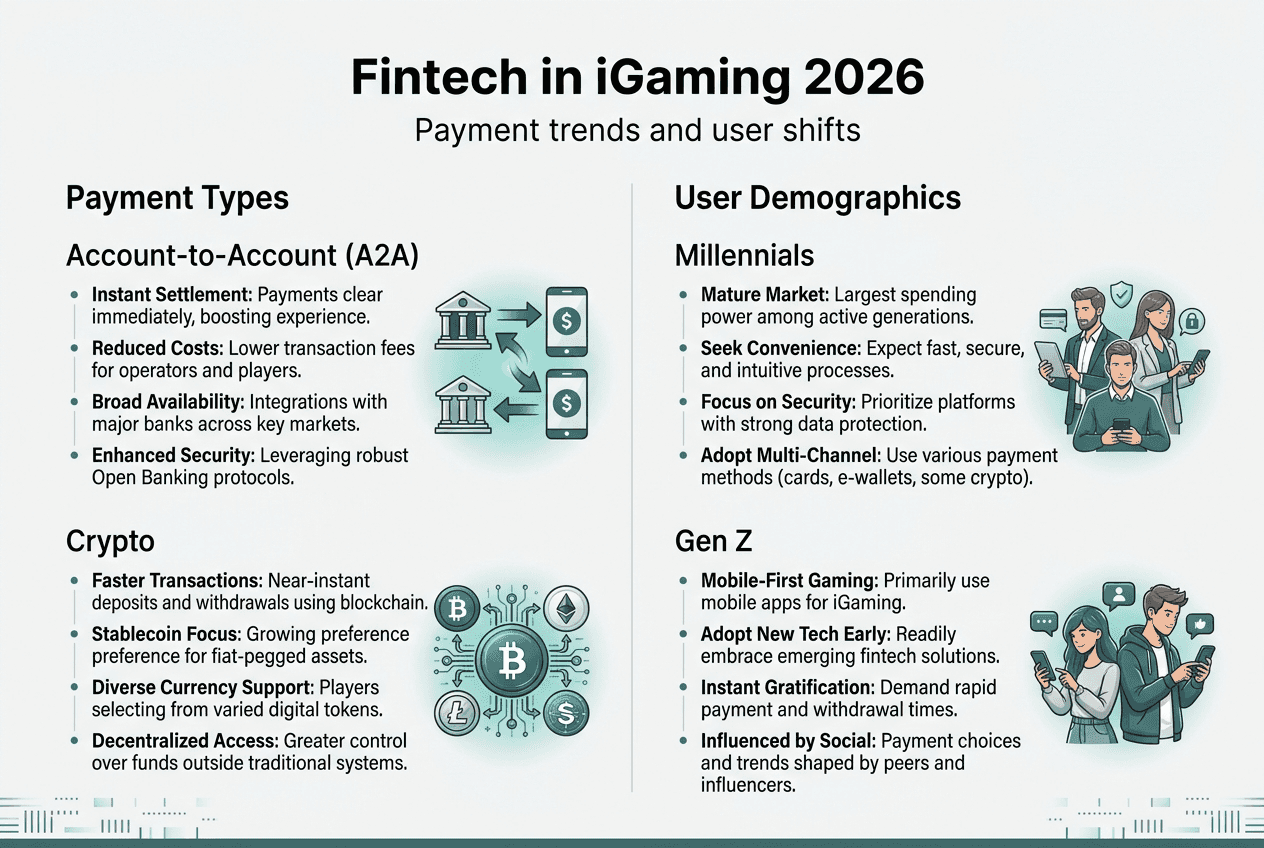
Real-time account-to-account payments represent one of fintech’s most significant contributions to iGaming. Platforms like Trustly, Zimpler, and Brite allow players to transfer funds directly from their bank accounts without intermediary steps. This approach has reduced failed deposits by over 40% compared to traditional card processing, dramatically improving conversion rates for operators who implement these solutions.
The benefits extend beyond simple transaction success rates:
-
Instant deposit confirmation eliminates waiting periods that cause players to abandon registration
-
Direct bank connections reduce fraud risk by removing card data from the transaction flow
-
Lower processing fees compared to traditional card networks improve operator margins
-
Enhanced user experience through streamlined checkout processes increases player retention
-
Automated compliance checks built into payment flows reduce regulatory burden
“Fintech innovations have transformed payments from a backend utility into a core user experience differentiator that directly impacts player acquisition and retention.”
Faster payment processing serves as more than a convenience feature. In competitive iGaming markets, the ability to offer instant deposits and withdrawals becomes a primary factor in player platform selection. Operators who leverage fintech payment solutions report higher initial deposit rates and improved lifetime value metrics compared to those relying solely on traditional payment rails.
The shift toward fintech-powered payments also addresses longstanding pain points in cross-border transactions. Traditional international payment methods often involve multiple intermediaries, currency conversion fees, and processing delays that frustrate players. Modern fintech solutions handle these complexities invisibly, presenting users with simple, localized payment options while managing the technical complexity behind the scenes.
This transformation sets the stage for understanding which specific payment methods are gaining traction and how market trends are evolving in 2026’s iGaming landscape.
Dominant fintech payment methods and market trends in 2026
The iGaming payment landscape has consolidated around several key fintech-enabled methods that dominate transaction volume. Digital wallets account for 45% of all iGaming transactions, reflecting player preference for stored-value accounts that enable instant deposits without repeatedly entering payment credentials.

The following table illustrates current adoption rates and growth trajectories for major payment methods:
| Payment Method | Transaction Share | Year-over-Year Growth | Primary User Demographic |
| Digital wallets | 45% | +18% | Mobile-first players aged 25-40 |
| Account-to-account | 28% | +32% | Desktop users preferring bank security |
| Cryptocurrency | 12% | +19% | Privacy-focused and tech-savvy players |
| Traditional cards | 15% | -8% | Older demographics and new players |
Market data reveals that 60% of operators now integrate at least one specialized fintech payment solution, with adoption rates projected to increase by 25% over the next 12 months. This rapid growth reflects both player demand and operator recognition that payment infrastructure directly impacts competitive positioning.
The global iGaming market reached €90.5 billion in 2025, growing at approximately 10.5% annually. Payment innovations serve as a primary driver of this expansion, with instant transfers and e-wallets enabling operators to enter new markets more efficiently.
Key factors driving fintech payment preference include:
-
Transaction speed that eliminates the friction of waiting for deposit confirmation
-
Enhanced security through tokenization and biometric authentication
-
User flexibility to switch between payment methods without creating new accounts
-
Lower total cost of ownership compared to maintaining multiple traditional payment integrations
-
Built-in compliance features that automatically adapt to local regulatory requirements
Cryptocurrency adoption deserves special attention despite its smaller current share. The 19% growth rate signals increasing mainstream acceptance, particularly among younger demographics who value transaction privacy and decentralized finance principles. Many operators initially dismissed crypto as a niche preference, but 2026 data suggests this view was shortsighted.
Pro Tip: Don’t underestimate cryptocurrency’s growth potential in your payment strategy. Even if crypto represents a small percentage of current transactions, offering it as an option attracts a highly engaged player segment with above-average lifetime value and can differentiate your platform in crowded markets.
The shift away from traditional card processing reflects both player preference and practical considerations. Card transactions face higher decline rates, chargeback risks, and processing fees that make them less attractive for both operators and players. E-wallets are preferred by 65% of players over card options when both are available, demonstrating clear market direction.
These market trends create both opportunities and challenges for operators. While fintech solutions offer clear advantages, implementing them effectively requires navigating complex compliance requirements and banking relationships that remain problematic in 2026.
Challenges and fintech-driven solutions in compliance and banking for iGaming
Despite fintech’s transformative potential, iGaming operators face persistent operational challenges that technology alone cannot fully resolve. Banking remains the biggest ongoing challenge for operators, even as regulatory frameworks mature and fintech solutions proliferate.
Successful fintech entrepreneurs and operators address these challenges through systematic approaches:
-
Engage specialized high-risk payment acquirers who understand iGaming’s unique risk profile and regulatory requirements
-
Diversify merchant account relationships across multiple providers and jurisdictions to reduce single-point-of-failure risk
-
Implement robust technical infrastructure that enables rapid switching between payment providers when banking relationships change
-
Maintain transparent communication with financial partners about business models, transaction volumes, and compliance measures
-
Build financial reserves to absorb potential account freezes or unexpected banking relationship terminations
Fintech solutions have made significant progress in addressing security and settlement challenges that compound banking difficulties. AI-based fraud detection improves security by 50% compared to rule-based systems, enabling operators to demonstrate lower risk profiles to potential banking partners. Machine learning models analyze transaction patterns in real time, identifying suspicious activity before it results in chargebacks or regulatory scrutiny.
Blockchain technology has reduced settlement times by 40% for operators who integrate distributed ledger solutions. Faster settlements improve cash flow management and reduce the capital requirements that make banking relationships challenging for smaller operators. The transparency inherent in blockchain systems also simplifies compliance reporting and audit processes.
Compliance best practices that fintech solutions support include:
-
Automated KYC verification that validates player identity in seconds rather than hours or days
-
Real-time AML monitoring that flags suspicious transaction patterns before they trigger regulatory attention
-
Instant payout processing that improves player satisfaction while maintaining compliance with withdrawal verification requirements
-
Geolocation verification integrated into payment flows to ensure regulatory compliance across jurisdictions
-
Comprehensive transaction audit trails that simplify regulatory reporting and demonstrate compliance to banking partners
The scale of fintech payment processing demonstrates market maturity. Trustly alone processed $85 billion in transactions during 2024, representing 54% year-over-year growth. This volume indicates that fintech payment solutions have moved beyond experimental status to become core infrastructure for the iGaming industry.
Pro Tip: When evaluating fintech payment partners, prioritize providers with established banking relationships and regulatory compliance track records over those offering the lowest processing fees. A slightly higher cost structure is worthwhile if it means more stable, long-term payment infrastructure that won’t disappear when banking conditions tighten.
The interplay between fintech innovation and banking challenges creates a complex environment for operators. Technology provides tools to mitigate risk and demonstrate compliance, but success requires strategic thinking about how to implement these solutions in ways that address both player needs and banking partner concerns.
Understanding these challenges provides context for developing practical implementation strategies that balance innovation with operational stability.
Practical strategies for integrating fintech payments and compliance in iGaming
Implementing fintech payment solutions requires strategic thinking that goes beyond simply adding new payment buttons to your platform. The following comparison helps operators evaluate different fintech payment types:
| Payment Type | Primary Benefits | Key Risks | Best Use Cases |
| Account-to-account | Lowest fees, highest security, instant confirmation | Limited geographic coverage, requires bank integration | Markets with strong instant payment infrastructure |
| E-wallets | Broad user adoption, fast checkout, stored credentials | Wallet provider dependencies, variable fees | Mobile-first platforms targeting mainstream players |
| Cryptocurrency | Privacy, low fees, global reach | Volatility risk, regulatory uncertainty | Tech-savvy demographics, jurisdictions with crypto-friendly regulations |
| Card processing | Universal acceptance, familiar UX | High decline rates, chargeback risk, expensive | New player acquisition, markets without alternative infrastructure |
Operators should follow these actionable steps when implementing fintech payment solutions:
-
Audit your current payment setup to identify failure points, high-cost transactions, and user experience friction
-
Prioritize payment methods based on your specific player demographics and geographic markets rather than industry-wide trends
-
Incorporate AI-powered fraud detection tools that learn from your transaction patterns to reduce false positives
-
Ensure compliance workflows are automated and integrated into payment processes rather than treated as separate systems
-
Monitor payment success rates and user conversion metrics continuously to identify optimization opportunities
-
Build redundancy into your payment infrastructure with backup providers for critical payment methods
Pro Tip: Start with pilot integrations of new fintech payment methods on a small percentage of traffic before full rollout. This approach reduces implementation risk, allows you to optimize user experience based on real data, and prevents widespread issues if technical integration problems arise.
Strategic fintech solution selection requires aligning payment capabilities with three critical factors. First, understand your users’ actual preferences through data analysis rather than assumptions. Second, ensure chosen solutions meet regulatory requirements in all jurisdictions where you operate. Third, verify that payment infrastructure can scale as your business grows without requiring complete reimplementation.
Fintech has shifted payments from a source of friction to a core user experience differentiator for iGaming operators. Features like Pay&Play, which allows instant gameplay without traditional registration, and instant payouts that process withdrawals in seconds rather than days, represent the competitive advantages that fintech enables.
The transformation of payments from backend utility to competitive advantage requires operators to think strategically about their payment infrastructure. Every decision about which fintech solutions to implement should consider both immediate operational needs and long-term strategic positioning. Operators who view payments as a strategic asset rather than a commodity service consistently outperform competitors in player acquisition and retention metrics.
As 2026 progresses, the gap between operators who effectively leverage fintech payment innovations and those relying on legacy infrastructure will widen. The insights and strategies outlined here provide a foundation for making informed decisions that position your iGaming business for sustainable growth in an increasingly competitive and regulated market.
Explore tailored banking and business solutions for your iGaming venture
Navigating the complex intersection of fintech payments, banking relationships, and regulatory compliance requires specialized expertise. Many iGaming operators struggle to find financial partners who understand the industry’s unique challenges and opportunities.
Deincepstart specializes in helping iGaming operators establish robust financial infrastructure that supports fintech-driven payment innovation. Our services address the banking hurdles and compliance requirements that often prevent operators from fully leveraging modern payment solutions. We assist with corporate bank account establishment, offshore structure setup, EMI and VASP licensing, and building compliant payment infrastructure tailored to high-risk industries.
Whether you’re launching a new iGaming platform or optimizing an existing operation, our banking and business solutions provide the foundation for implementing the fintech payment strategies discussed in this guide. We help you navigate regulatory requirements, establish reliable banking relationships, and build payment infrastructure that scales with your business.
Frequently asked questions
What is fintech’s role in iGaming payments?
Fintech enables real-time payment processing, reduces transaction failures, and improves user experience through innovations like instant bank transfers, digital wallets, and AI-powered fraud detection. These technologies transform payments from a friction point into a competitive advantage for operators.
How do fintech solutions reduce payment failures?
Fintech payment methods like account-to-account transfers bypass traditional card networks, eliminating common decline reasons such as issuer restrictions and outdated card data. Direct bank connections and instant verification reduce failed deposits by over 40% compared to legacy payment methods.
What challenges do iGaming operators face with banking and compliance?
Banking remains the primary challenge, with many financial institutions reluctant to serve iGaming businesses due to perceived risk. Operators must engage specialized high-risk acquirers, diversify merchant relationships, and implement robust compliance measures including automated KYC, AML monitoring, and transaction reporting to maintain stable banking partnerships.
Which payment methods are growing fastest in iGaming?
Account-to-account payments show the highest growth at 32% year-over-year, followed by cryptocurrency at 19% and digital wallets at 18%. Traditional card processing is declining as players prefer faster, more secure alternatives that fintech solutions provide.
How can operators select the right fintech payment solutions?
Operators should analyze their specific player demographics, geographic markets, and regulatory requirements rather than following industry-wide trends. Pilot new payment methods on limited traffic, prioritize providers with strong compliance track records, and ensure solutions can scale as the business grows without requiring complete reimplementation.