

Fintech startups in high-risk sectors face unprecedented challenges securing banking relationships and managing compliance costs. Traditional banks are closing 44% of UK fintech accounts due to de-risking pressures, while regulatory requirements push compliance expenses beyond $1 million annually. Offshore structures, specialized e-money institutions, and emerging RegTech solutions offer practical pathways forward. This guide walks you through banking alternatives, licensing requirements, and cost-reduction strategies that help high-risk fintechs establish compliant financial operations without breaking the bank.
Table of Contents
- Key Takeaways
- Understanding the fintech banking landscape and compliance challenges
- Offshore banking and e-money institutions as alternatives
- Navigating licensing and regulatory compliance for fintech startups
- Leveraging RegTech and AI to optimize compliance and reduce costs
- Explore banking and business solutions designed for fintech startups
- Frequently asked questions
Key Takeaways
| Point | Details |
|---|---|
| High compliance costs | Compliance expenses for high risk fintechs can exceed one million dollars annually, straining budgets. |
| Derisking pressure | Traditional banks terminate relationships with high risk fintechs under derisking pressure, creating a banking desert. |
| Offshore options | Offshore jurisdictions and specialized EMIs offer viable alternatives, but come with trade offs in cost, regulatory complexity, and reputation. |
| AI RegTech savings | AI and RegTech solutions can reduce compliance costs by 75 to 88 percent through automation. |
Understanding the fintech banking landscape and compliance challenges
Fintech startups operating in iGaming, crypto, and cross-border payments face a regulatory environment that's become significantly more hostile. Compliance costs range from €500k to €1.2M for EU EMI licenses and $600k to $1.25M for US multi-state operations. These figures don't include ongoing operational expenses for transaction monitoring, reporting, and staff training.
Traditional banks view high-risk fintechs as liability magnets. Anti-money laundering regulations impose steep penalties for compliance failures, pushing banks to terminate relationships rather than manage risk. The result is a banking desert for legitimate startups that happen to operate in sectors flagged as high-risk. You might have a solid business model, clean operations, and proper documentation, but still face account closures with minimal notice.
Global financial crime compliance costs the industry $206 billion annually, with fintechs bearing disproportionate burdens relative to their size. Manual compliance processes drain resources that could fuel product development and market expansion. Many founders spend more time managing regulatory paperwork than building their core technology.
The good news is that AI and RegTech solutions reduce these costs by 75-88% through automation and intelligent monitoring. These tools handle transaction screening, customer due diligence, and regulatory reporting with minimal human intervention. Early adopters gain competitive advantages by reallocating compliance budgets toward growth initiatives.
Pro Tip: Document every compliance process from day one. Regulators reward transparency and preparedness with faster approvals and lighter scrutiny during audits.
The compliance landscape includes these critical pain points:
- Onboarding timelines stretching 3 to 6 months due to extensive due diligence requirements
- Risk of fines exceeding $250k for 60% of fintechs facing regulatory violations
- Constant regulatory changes requiring ongoing legal interpretation and system updates
- Limited access to banking and business solutions designed for high-risk sectors
"The regulatory burden on fintech startups has reached a tipping point where compliance costs often exceed technology development budgets, forcing founders to choose between growth and survival."
This reality demands strategic thinking about jurisdictional selection, banking partnerships, and technology infrastructure from the earliest stages of company formation.
Offshore banking and e-money institutions as alternatives
When traditional banks close their doors, offshore jurisdictions and specialized e-money institutions provide viable alternatives. These options come with trade-offs around cost, regulatory complexity, and reputational considerations that require careful evaluation.
Specialist EMIs operate under e-money licenses that permit them to hold client funds and facilitate payments without full banking licenses. They understand high-risk business models better than traditional banks and structure their due diligence processes accordingly. Expect higher fees than standard business accounts, typically 0.5% to 2% per transaction, plus monthly maintenance charges between $500 and $2,000.

Offshore banking jurisdictions offer different regulatory frameworks that may align better with your business model. The Cayman Islands, UAE, and Liechtenstein lead as fintech-friendly destinations, each with distinct advantages. Cayman provides strong financial privacy and established infrastructure for fund management. UAE offers modern banking technology and growing fintech ecosystems in Dubai and Abu Dhabi. Liechtenstein combines EU market access with flexible regulatory approaches.
| Jurisdiction | Setup Cost | Annual Fees | Regulatory Burden | Banking Access |
|---|---|---|---|---|
| Cayman Islands | $15k-$25k | $8k-$15k | Moderate | Excellent |
| UAE (DIFC) | $20k-$35k | $12k-$20k | Moderate-High | Very Good |
| Liechtenstein | $25k-$40k | $15k-$25k | High | Excellent |
| Seychelles | $8k-$15k | $4k-$8k | Low | Good |
| Mauritius | $12k-$20k | $6k-$12k | Moderate | Good |
Each jurisdiction requires different documentation, capital requirements, and ongoing reporting obligations. Cayman demands substance through local directors and physical presence. UAE requires sponsorship arrangements and compliance with free zone regulations. Liechtenstein mandates robust AML programs and regular audits.
Pro Tip: Match your jurisdiction choice to your target markets and payment corridors. Operating in Europe requires different structures than serving Asian or Latin American customers.
Key considerations when evaluating offshore banking options include:
- Reputation impact on customer trust and partnership opportunities
- Currency support and foreign exchange capabilities for your payment flows
- Integration capabilities with payment processors and fintech infrastructure
- Regulatory stability and political risk in the chosen jurisdiction
- Exit strategies if regulations change or banking relationships deteriorate
The shift toward offshore solutions reflects broader market realities. Banks continue exiting high-risk relationships, leaving startups with limited choices. Specialist providers fill this gap by building compliance frameworks specifically designed for crypto, iGaming, and cross-border payment businesses. These relationships require transparency about your business model, customer base, and transaction patterns from the initial application.
Working with experienced advisors who understand both offshore structures and fintech operations significantly improves approval rates. They navigate documentation requirements, introduce you to appropriate banking partners, and structure entities to optimize both compliance and operational efficiency. The investment in professional guidance typically pays for itself through faster onboarding and better banking terms.
Navigating licensing and regulatory compliance for fintech startups
Licensing transforms your startup from an interesting project into a regulated financial institution. The process involves multiple regulatory bodies, extensive documentation, and significant capital commitments. Understanding the workflow helps you plan resources and timelines realistically.
Typical licensing processes follow these stages:
-
Pre-application preparation involves business plan development, compliance framework design, and capital raising. Expect 2 to 4 months assembling documentation and building internal systems before formal submission.
-
Application submission requires detailed disclosures about beneficial owners, business models, risk management procedures, and financial projections. Regulators scrutinize every aspect of your operations and leadership team.
-
Regulatory review spans 3 to 6 months as authorities assess your application, request clarifications, and conduct background checks on key personnel. Response time to regulator questions directly impacts approval timelines.
-
Conditional approval comes with requirements to demonstrate operational readiness, finalize banking relationships, and implement compliance monitoring before commencing operations.
-
Final authorization permits you to onboard customers and process transactions under ongoing regulatory supervision and reporting obligations.
Compliance frameworks vary by jurisdiction but share common elements. Anti-money laundering and know-your-customer procedures form the foundation. You need documented policies for customer onboarding, transaction monitoring, suspicious activity reporting, and record retention. 60% of fintechs face fines exceeding $250k for compliance failures, making robust systems non-negotiable.
European fintechs must comply with PSD2 requirements for payment services, including strong customer authentication and open banking APIs. US operations require state-by-state money transmitter licenses, each with unique bonding requirements and application processes. Multi-jurisdictional operations multiply complexity exponentially.
Pro Tip: Engage specialized compliance consultants 6 months before your target launch date. Their experience navigates regulatory nuances and prevents costly delays from incomplete applications.
Common obstacles that extend licensing timelines include:
- Incomplete beneficial ownership documentation and corporate structure transparency
- Insufficient capital buffers beyond minimum regulatory requirements
- Weak risk management frameworks lacking specific procedures for identified threats
- Inadequate technology infrastructure for transaction monitoring and reporting
- Leadership team members with regulatory concerns in their backgrounds
Regulatory expectations continue evolving. Financial crime regulations adapt to new threats, requiring ongoing system updates and staff training. Budget for compliance as a permanent operational expense, not a one-time licensing cost. Successful fintechs build compliance into their culture and product development from inception.
The investment in proper licensing and compliance infrastructure protects your business from existential threats. Regulatory violations can result in license revocation, criminal penalties for executives, and reputational damage that destroys customer trust. View compliance as competitive advantage rather than bureaucratic burden. Well-designed systems enable faster customer onboarding, better risk management, and stronger banking relationships.
Leveraging RegTech and AI to optimize compliance and reduce costs
Manual compliance processes can't scale with fintech growth. RegTech solutions automate repetitive tasks, improve accuracy, and dramatically reduce operational costs. The technology has matured to the point where even early-stage startups can access enterprise-grade compliance capabilities.
AI-driven tools excel at pattern recognition in transaction data. They identify suspicious activities, flag high-risk customers, and generate regulatory reports without human intervention. Machine learning models improve over time, adapting to new fraud patterns and regulatory requirements automatically. This adaptability proves crucial as financial crime tactics evolve.
AI and RegTech reduce compliance costs by 75-88% compared to manual processes. The savings come from reduced staffing needs, faster processing times, and fewer errors requiring remediation. A compliance team of 10 people can often be replaced by 2 people managing automated systems.
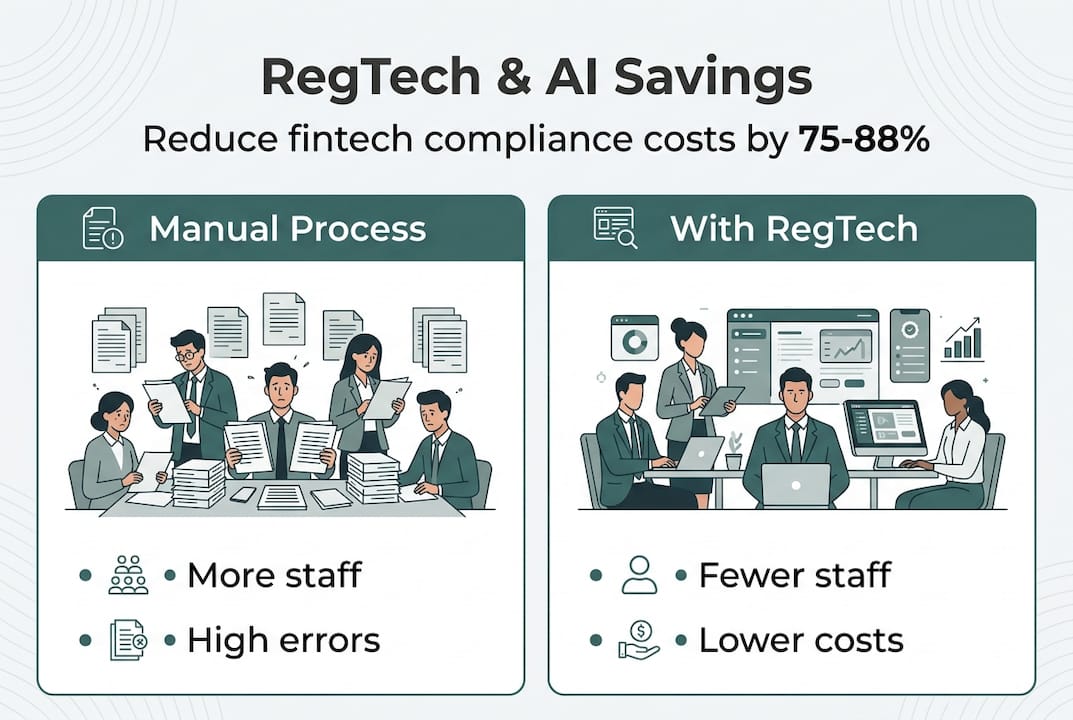
| Compliance Approach | Setup Cost | Monthly Operating Cost | Onboarding Time | Error Rate |
|---|---|---|---|---|
| Manual processes | $50k-$100k | $40k-$80k | 5-10 days | 3-7% |
| RegTech-enabled | $20k-$40k | $5k-$15k | 1-2 days | 0.1-0.5% |
Popular RegTech applications for fintech startups include:
- Identity verification platforms using biometric authentication and document analysis
- Transaction monitoring systems applying machine learning to detect anomalies
- Regulatory reporting tools that automatically generate required filings
- Risk scoring engines that assess customer and transaction risk in real time
- Sanctions screening services checking customers against global watchlists
Integration capabilities matter as much as functionality. Your RegTech stack must connect seamlessly with payment processors, banking partners, and internal systems. APIs enable data flow between platforms without manual data entry or file transfers. Cloud-based solutions offer scalability and regular updates without infrastructure management.
Pro Tip: Implement RegTech during your initial build phase rather than retrofitting later. Early integration prevents technical debt and ensures compliance scales with your growth.
The strategic advantage extends beyond cost savings. Automated compliance enables faster customer onboarding, improving conversion rates and customer experience. Real-time risk assessment allows you to accept more customers safely by identifying and monitoring higher-risk profiles rather than rejecting them outright. Better data analytics inform business decisions about product development and market expansion.
Selecting the right RegTech partners requires evaluating their regulatory expertise, technology reliability, and support capabilities. Look for providers with experience in your specific sector and target jurisdictions. Check their regulatory certifications and audit history. Test their customer support responsiveness before committing to long-term contracts.
Cost structures vary widely. Some providers charge per transaction, others use monthly subscriptions based on volume tiers. Calculate total cost of ownership including implementation, training, and ongoing support. The cheapest option rarely delivers the best value when you factor in reliability, accuracy, and scalability.
Regulatory acceptance of RegTech solutions has grown significantly. Many jurisdictions now recognize automated systems as meeting compliance obligations when properly implemented and monitored. Document your RegTech selection process, validation testing, and ongoing performance monitoring to demonstrate regulatory diligence.
The compliance landscape will continue shifting toward technology-enabled approaches. Regulators themselves adopt AI and data analytics for supervision, creating expectations that regulated entities do the same. Early adopters of robust RegTech infrastructure position themselves advantageously for future regulatory developments and competitive pressures.
Explore banking and business solutions designed for fintech startups
Navigating high-risk fintech banking requires specialized expertise and established relationships that most startups lack. Professional advisory services bridge this gap by connecting you with appropriate banking partners, structuring compliant offshore entities, and managing licensing applications across multiple jurisdictions.
Tailored solutions address the specific challenges fintech startups face in securing banking relationships and regulatory approvals. Experienced advisors understand which banks and EMIs accept different business models, what documentation they require, and how to present applications for maximum approval likelihood. This knowledge reduces rejection rates and accelerates onboarding from months to weeks.
Offshore structure design requires balancing compliance requirements, tax efficiency, and operational flexibility. Professional guidance ensures your corporate architecture supports current operations while enabling future expansion. The right structure minimizes regulatory friction and positions you for partnerships with payment processors and banking institutions.
Licensing support encompasses application preparation, regulator communication, and compliance framework development. Advisors with regulatory relationships can often facilitate faster reviews and provide insights into regulator expectations. Their experience prevents common mistakes that delay approvals or trigger additional scrutiny.
Explore comprehensive banking and business solutions that help high-risk fintechs establish compliant financial operations efficiently. The investment in professional guidance typically returns multiples through faster market entry, better banking terms, and reduced compliance costs.
Frequently asked questions
What are the typical compliance costs for fintech startups?
Compliance costs vary significantly based on jurisdiction and license type. EU EMI licensing requires €500k to €1.2M, while US multi-state operations cost $600k to $1.25M. These figures include initial licensing, system implementation, and first-year operational expenses. AI and RegTech solutions can reduce ongoing costs by 75-88% through automation.
How can fintech startups avoid bank account closures due to de-risking?
Specialist e-money institutions and offshore banks provide alternatives to traditional banking relationships. UK banks closed 44% of fintech accounts in 2024, driving startups toward providers experienced with high-risk sectors. Maintain transparent communication about your business model, implement robust compliance monitoring, and work with banking and business solutions that understand your industry. Proactive compliance and strong documentation significantly reduce closure risk.
What is the typical onboarding timeline for licensing in fintech?
Licensing typically requires 3 to 6 months from application submission to final approval, though complex multi-jurisdictional applications can extend longer. Pre-application preparation adds another 2 to 4 months for business plan development and compliance framework design. Engaging experienced consultants early shortens timelines by ensuring complete applications and efficient regulator communication.
Which offshore jurisdictions work best for fintech banking?
Cayman Islands, UAE, and Liechtenstein lead for fintech banking access and regulatory clarity. Cayman offers strong privacy and established financial infrastructure. UAE provides modern technology ecosystems and growing fintech sectors. Liechtenstein combines EU market access with flexible regulations. Jurisdiction selection should align with your target markets, payment corridors, and growth strategy rather than solely minimizing costs.
How does RegTech improve fintech compliance efficiency?
RegTech automates transaction monitoring, customer due diligence, and regulatory reporting through AI and machine learning. These tools reduce compliance costs by 75-88% while improving accuracy and processing speed. Automated systems enable faster customer onboarding, better risk management, and scalable operations without proportional staff increases. Early RegTech adoption prevents technical debt and ensures compliance infrastructure grows with your business.