

Cross-border payments cost iGaming and fintech companies far more than the transaction fee on the wire. Global remittance costs averaged 6.62% in Q3 2024, and that figure does not account for compliance overhead, failed transactions, or the revenue lost when a player cannot withdraw funds in their local currency. This guide walks corporate decision-makers through the full lifecycle of building a compliant, efficient, and scalable cross-border payment operation, from diagnosing the real cost of friction to selecting the right technology stack and running it at scale.
Table of Contents
- Understanding cross-border payment challenges
- Essential requirements for compliant solutions
- Choosing your payment solution: Options and trade-offs
- Implementation: Step-by-step process for corporate teams
- Monitoring, optimization, and troubleshooting
- How Deincepstart helps streamline cross-border payments
- Frequently asked questions
Key Takeaways
| Point | Details |
|---|---|
| Remittance costs remain high | Despite fintech innovation, transaction fees for global payments often exceed 6 percent. |
| Compliance is essential | Licensing, KYC/AML, and ongoing data monitoring reduce legal exposure and foster trust with providers. |
| Stablecoins & CBDCs are emerging leaders | Stablecoins demonstrate lower barriers and costs for cross-border flows, while CBDCs offer future promise for further reductions. |
| Execution requires detailed planning | A clear, stepwise process from provider selection to post-launch monitoring is key to success. |
Understanding cross-border payment challenges
The pain is not abstract. When an iGaming operator processes thousands of player payouts daily across a dozen currencies, even a 1% improvement in settlement efficiency translates directly to the bottom line. The problem is that the global payment system was not built for high-frequency, high-risk industries. It was built for banks.
The FSB's G20 roadmap data shows slight improvements in speed and transparency, but high costs remain stubbornly persistent. That gap between ambition and reality is where most fintech and iGaming operators lose money every quarter.
| Method | Avg. cost | Settlement time | Compliance burden |
|---|---|---|---|
| SWIFT wire | 3%–5% | 1–5 business days | High |
| Digital wallets | 1%–2.5% | Minutes to hours | Medium |
| Stablecoins | 0.1%–0.5% | Minutes | Medium to high |
| SEPA (EUR zone) | Near zero | Same day | Medium |
Cost is the last problem to get solved. Despite years of fintech innovation, the global remittance cost report confirms that the G20 target of 3% average cost remains out of reach for most corridors. For iGaming operators running high-volume payouts, this is not a rounding error.
Sector-specific stressors compound the problem. iGaming companies face layered regulatory regimes across jurisdictions, meaning a single payout corridor might require compliance with three separate licensing frameworks. Opening the right iGaming fintech bank accounts is often the first structural decision that determines whether your payment rails will hold under volume.
Essential requirements for compliant solutions
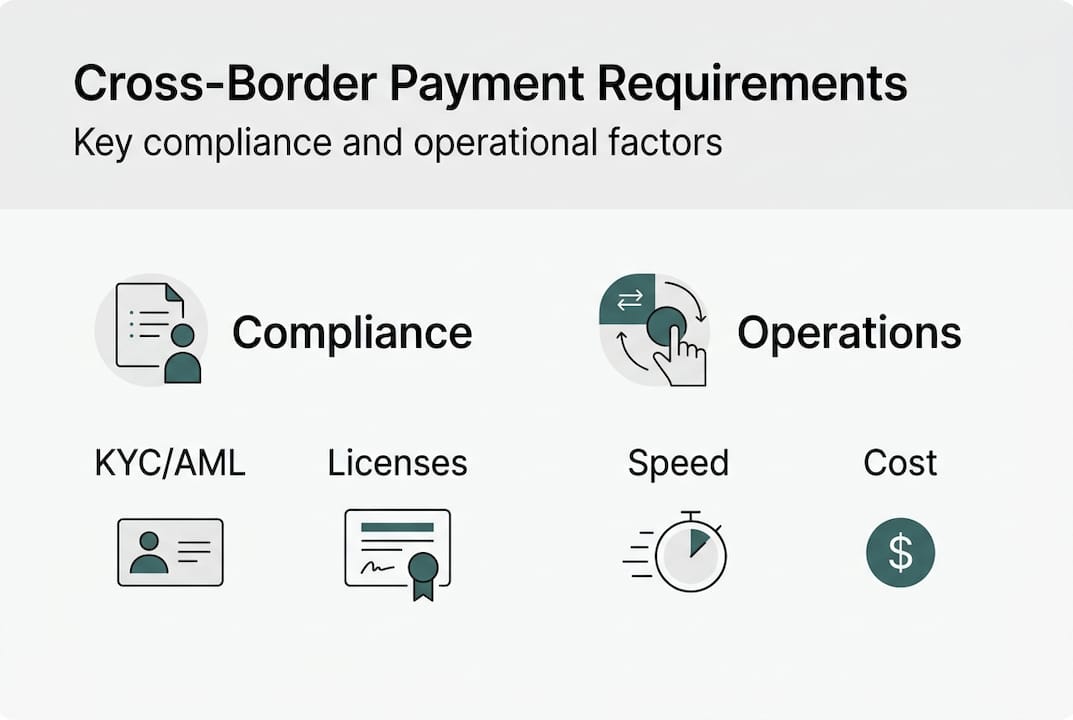
Before you select a payment provider or sign an API agreement, your legal and operational foundation must be solid. Skipping this step is how companies end up blacklisted from correspondent banking networks or fined by financial regulators in their target markets.
Here are the non-negotiable prerequisites:
- Licensing: Obtain the appropriate Money Services Business (MSB) license, Electronic Money Institution (EMI) authorization, or equivalent for each jurisdiction you operate in. Review fintech license examples relevant to high-risk sectors before committing to a structure.
- KYC/AML protocols: Implement real-time identity verification and transaction screening against global sanctions lists. This is table stakes, not optional.
- Transaction monitoring: Deploy automated systems that flag unusual patterns, high-value transfers, and velocity anomalies before they become regulatory events.
- Data privacy compliance: Align with GDPR, PDPA, or local equivalents depending on where your customers reside. Cross-border data flows are increasingly scrutinized.
- Startup compliance essentials: Review your startup compliance essentials checklist before onboarding any new payment corridor.
The FSB policy recommendations specifically target data frictions and non-bank access as barriers to efficient cross-border payments. That means regulators are watching how companies handle data sharing across borders, and non-compliance is not just a fine risk. It is a market access risk.
Pro Tip: Engage a cross-jurisdiction regulatory advisor before you scale payment volume beyond your home market. The cost of that advice is a fraction of a single enforcement action.
Choosing your payment solution: Options and trade-offs
Not every payment rail fits every use case. The right architecture depends on your transaction volume, payout corridors, customer base, and risk tolerance. Here is how the major options stack up.
| Solution | Cost | Speed | Compliance complexity | Best for |
|---|---|---|---|---|
| SWIFT | High | Slow | High | Large institutional transfers |
| SEPA | Very low | Fast (EUR only) | Medium | European player payouts |
| Correspondent banking | Medium | Medium | High | Emerging market corridors |
| Digital wallets | Low | Fast | Medium | Consumer-facing payouts |
| Stablecoins | Very low | Near-instant | Medium to high | Global, unbanked corridors |
| CBDCs | TBD | Fast (pilots) | Regulatory dependent | Future infrastructure |
Cross-border stablecoin flows peaked at $2.6T in 2021, and BIS research confirms they are less affected by distance and capital flow measures than traditional payment flows. That makes stablecoins particularly attractive for iGaming operators paying out to players in high-remittance corridors like Southeast Asia, Latin America, and Sub-Saharan Africa.
Looking further ahead, CBDCs could reduce payment costs by $510B annually once adoption reaches scale. That is a compelling long-term case, but most operators need solutions that work today.
Factors unique to iGaming and fintech that should drive your selection:
- Transaction frequency: Are you processing hundreds or hundreds of thousands of payouts per day?
- Payout corridor concentration: Do 80% of your players sit in three countries, or fifty?
- Regulatory exposure: Which jurisdictions require local licensing for payment processing?
- Chargeback and fraud risk: Some rails offer stronger dispute resolution than others.
For a deeper look at how these technologies apply operationally, the iGaming payment technologies guide and offshore payment alternatives are worth reviewing before finalizing your architecture.
Implementation: Step-by-step process for corporate teams
Strategy without execution is just a slide deck. Here is the operational sequence that works for iGaming and fintech teams building or rebuilding their cross-border payment infrastructure.
- Due diligence: Audit your current payment flows. Map every corridor, identify cost centers, and document compliance gaps. You cannot optimize what you have not measured.
- Solution selection: Match your corridor and volume profile to the right rail or combination of rails. Most mature operators run hybrid stacks.
- Integration: Connect via API to your chosen provider. Build KYC verification into the onboarding flow and configure settlement accounts for each currency.
- Trial transactions: Run low-value test transactions across every corridor before going live. Verify settlement times, fee structures, and failure handling.
- Compliance sign-off: Have your legal team or external advisor review the live configuration against your licensing obligations before scaling.
- Scaling: Increase volume incrementally. Monitor failure rates and compliance flags in real time.
IMF benchmarks confirm that while real-time payment systems like FedNow challenge domestic incumbents, stablecoins outperform for cross-border and unbanked use cases. CBDCs show promise but interoperability hurdles remain in current pilots. That means your implementation plan should account for a hybrid approach, not a single-rail bet.

Pro Tip: Always use sandbox or test environments provided by your payment provider before processing real money. A misconfigured settlement account in a live environment can freeze funds for weeks.
For operators building from scratch, the iGaming operator payment guide and corporate account approval steps provide the structural context you need before going live.
Monitoring, optimization, and troubleshooting
Going live is not the finish line. Payment infrastructure degrades without active management. Regulatory requirements shift. Providers change fee structures. Corridors that worked last quarter may face new restrictions this quarter.
Track these KPIs consistently:
- Cost per transaction: Broken down by corridor and rail, not blended averages.
- Settlement time: Average and worst-case, by corridor.
- Transaction failure rate: Anything above 2% warrants immediate investigation.
- Compliance event rate: How often are transactions flagged, and how quickly are they resolved?
- Chargeback ratio: Especially critical for iGaming operators under acquiring bank scrutiny.
The most common operational failure is not a technology problem. It is a process problem. Manual reconciliation delays, missed regulatory filings, and slow KYC reviews create cascading failures that no payment technology can fix. Build the process before you scale the volume.
The FSB's continuous improvement mandate under the G20 roadmap means regulators expect operators to demonstrate ongoing optimization, not just point-in-time compliance. Schedule quarterly audits of your payment stack and renegotiate provider contracts annually based on volume and performance data.
For operators considering Hong Kong as a banking hub for their payment infrastructure, understanding why Hong Kong bank accounts work well for iGaming and fintech is a useful starting point for structuring your treasury operations.
How Deincepstart helps streamline cross-border payments
Building compliant, scalable cross-border payment infrastructure is not a one-time project. It is an ongoing operational discipline that requires deep knowledge of banking relationships, licensing frameworks, and payment technology across multiple jurisdictions.

At Deincepstart, we work directly with iGaming operators, fintech companies, and crypto businesses to design and implement payment infrastructure that holds up under regulatory scrutiny and scales with your growth. From securing the right corporate bank accounts and EMI licenses to structuring offshore entities in BVI, Cayman, or Mauritius, we handle the complexity so your team can focus on the product. If you are ready to build payment infrastructure that actually works across borders, explore our banking and business solutions and connect with our advisory team.
Frequently asked questions
What is the average cost of sending money cross-border for businesses?
The global average is 6.62% of the transaction amount as of Q3 2024, though costs vary significantly by method, corridor, and transaction size.
Are digital assets like stablecoins truly viable for iGaming cross-border payments?
Yes. Stablecoin flows reached $2.6T in 2021 and BIS research confirms they face fewer distance and regulatory friction barriers than traditional rails, making them a strong fit for high-remittance corridors.
What is the main compliance risk for cross-border payments?
Failing to meet licensing or KYC/AML requirements in target markets. The FSB policy framework highlights data frictions and non-bank access gaps as the primary structural risks operators must address.
Will CBDCs significantly lower my company's payment costs soon?
CBDCs could cut costs by $510B annually at scale, but current pilots still face interoperability barriers that make near-term adoption uncertain for most operators.
Which KPIs should I track for cross-border payment performance?
Prioritize cost per transaction by corridor, settlement time, transaction failure rate, and compliance event frequency. The G20 KPI framework also emphasizes transparency metrics as a core performance indicator.