

Foreign currency fees are quietly draining your profits. For iGaming operators and fintech firms running cross-border operations, traditional banking can cost you 20-30% more in FX markups and transaction delays compared to modern multi-currency solutions. Most founders don't realize the damage until they're scaling into new markets and watching margins shrink with every international transfer. Multi-currency accounts change that equation entirely. In this guide, you'll learn exactly how these accounts work, why they matter for high-risk industries, what compliance traps to avoid, and how to choose a banking partner that actually supports your growth.
Table of Contents
- What is a multi-currency account?
- Why open a multi-currency account? Core benefits
- Regulatory and compliance considerations
- Choosing the right multi-currency banking partner
- The real-world secret: Multi-currency banking is your growth lever
- Next steps: Secure your multi-currency business edge
- Frequently asked questions
Key Takeaways
| Point | Details |
|---|---|
| Save on FX fees | Multi-currency accounts help avoid hidden foreign exchange costs and offer better rates than traditional banks. |
| Operational speed | Handle cross-border payments and settlements faster to keep revenues flowing and suppliers happy. |
| Compliance matters | Choosing a regulated provider with local payment access ensures safety and reduces account freezes. |
| Scalable growth | The right multi-currency banking partner supports quick international scaling without compliance headaches. |
What is a multi-currency account?
Before you can use a tool effectively, you need to understand how it works. A multi-currency account is a single corporate account that lets you hold and manage funds in several currencies at once, without converting every incoming payment into your home currency. Think of it as a financial hub with multiple currency compartments, each operating independently.
Traditional single-currency corporate accounts force every foreign payment through a conversion process. That means fees, delays, and exchange rate risk every single time. A multi-currency account eliminates most of that friction by letting you receive EUR from European players, hold GBP for UK suppliers, and pay out in USD to American partners, all from one account dashboard.
Here's a quick comparison of the two account types:
| Feature | Traditional account | Multi-currency account |
|---|---|---|
| Currencies supported | 1 (home currency) | 10 to 50+ currencies |
| FX conversion on receipt | Always | Only when needed |
| International transfer speed | 2 to 5 business days | Same day to 24 hours |
| FX markup fees | 2% to 4% per transaction | 0.5% to 1.5% typical |
| Compliance flexibility | Limited | Designed for global ops |
Key features that make multi-currency accounts valuable for iGaming and fintech firms include:
- Multiple currency wallets within one account structure
- Local payment rails in key markets (SEPA, ACH, Faster Payments)
- Real-time FX conversion at interbank or near-interbank rates
- Consolidated reporting across all currencies for accounting and compliance
- API integrations for payment platforms and gaming back-office systems
If you're new to corporate banking structures, reviewing corporate banking basics will give you a solid foundation. You can also explore business bank account types to understand where multi-currency accounts fit within your broader financial setup.
Why open a multi-currency account? Core benefits
Understanding the mechanics is one thing. Seeing the direct business impact is another. Multi-currency accounts deliver measurable advantages that go well beyond convenience.
The most immediate benefit is cost reduction. Cutting costs 20-30% compared to traditional bank FX fees is realistic when you eliminate forced conversions and reduce wire transfer charges. For an iGaming operator processing $2 million per month in cross-border transactions, that's $400,000 to $600,000 saved annually.

Here's how fee structures compare across common currency corridors:
| Currency pair | Traditional bank fee | Multi-currency account fee | Annual saving (on $1M volume) |
|---|---|---|---|
| USD to EUR | 2.5% to 3.5% | 0.5% to 1% | Up to $25,000 |
| USD to GBP | 2.5% to 4% | 0.5% to 1.2% | Up to $28,000 |
| EUR to GBP | 2% to 3% | 0.4% to 0.9% | Up to $21,000 |
Beyond cost savings, the operational improvements are significant:
- Faster settlements mean you can pay affiliates, suppliers, and licensing bodies on time, every time, without waiting for bank processing windows.
- Improved cash flow visibility across markets lets your finance team make smarter decisions about when to convert and when to hold.
- Stronger supplier relationships come from being able to pay in your partners' preferred currency without extra charges.
- Reduced currency risk by holding balances in the currencies you actually spend, rather than converting at unfavorable rates.
- Credibility with regulated partners who expect professional, multi-currency banking infrastructure from serious operators.
Pro Tip: Don't convert foreign currency receipts immediately. Hold balances in the received currency and convert only when the rate is favorable or when you have a specific payment obligation. This simple practice can save thousands per month.
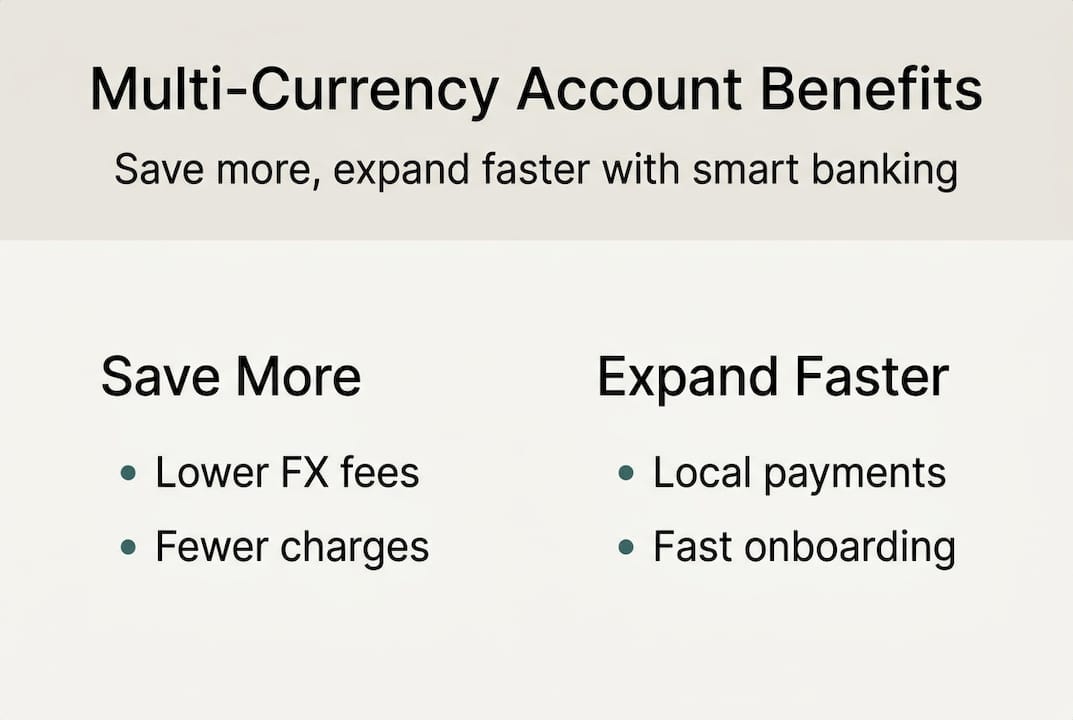
For a deeper breakdown of FX fee advantages and how they apply to your specific business model, or to explore cross-border payment solutions tailored to iGaming and fintech, both resources are worth reviewing before you commit to a provider.
Regulatory and compliance considerations
Cost savings mean nothing if your account gets frozen. Compliance is the single biggest risk factor for iGaming and high-risk fintech firms opening multi-currency accounts, and it's where most operators make costly mistakes.
Choosing a regulated provider with both local and cross-border payment rails is not optional for high-risk sectors. It's the baseline requirement. A provider operating without proper licensing in your target markets exposes your entire operation to account termination, fund seizure, and regulatory scrutiny.
"The difference between a compliant multi-currency account and an unregulated one isn't just paperwork. It's the difference between a banking relationship that scales with your business and one that collapses at the worst possible moment."
Key compliance considerations for iGaming and fintech operators:
- KYC and AML requirements: Your provider must have robust Know Your Customer and Anti-Money Laundering processes. Weak KYC on their end creates risk for you.
- Licensing jurisdiction: Verify that your provider holds licenses in every jurisdiction where they process payments, not just their home country.
- Source of funds documentation: Be prepared to demonstrate the legitimacy of your revenue streams, especially for gaming-derived income.
- Transaction monitoring: Reputable providers flag unusual patterns. Understand their thresholds and reporting obligations before you onboard.
- Correspondent banking relationships: Providers with strong correspondent networks reduce the risk of payment rejections from receiving banks.
Pro Tip: Before signing any agreement, ask your provider for their full regulatory license list and their enforcement history. A provider that hesitates to share this information is a red flag.
For practical guidance on navigating the onboarding process, the approval guide covers what banks and EMIs actually look for. The compliance guidance resource and verification best practices article are equally useful for preparing your documentation correctly the first time.
Choosing the right multi-currency banking partner
Not all multi-currency providers are built for high-risk, high-volume international businesses. Choosing the wrong one costs you time, money, and sometimes your entire banking relationship.
Here's a practical selection framework:
- Regulatory status: Confirm the provider holds an EMI license, banking license, or equivalent authorization in the jurisdictions that matter to your business.
- Local payment rail access: Direct access to SEPA, ACH, SWIFT, and regional networks means faster settlements and lower fees than providers routing through intermediaries.
- FX rate transparency: Ask for their spread over the interbank rate. Anything above 1.5% for major currency pairs is worth negotiating or walking away from.
- Onboarding timeline: For high-risk industries, expect 4 to 12 weeks. Any provider promising instant approval for iGaming or crypto businesses should be treated with skepticism.
- Support quality: Test their support before you sign. Send a complex compliance question and see how they respond.
Warning signs to avoid:
- Vague terms of service that don't specify which currencies, jurisdictions, or business types are supported
- No published enforcement or compliance history available on request
- Slow or evasive responses to questions about licensing
- Promises of guaranteed approval for high-risk businesses without due diligence
Selecting a provider with strong local networks and regulatory coverage is vital for business continuity, especially when you're operating across multiple jurisdictions simultaneously.
Pro Tip: Prioritize providers with direct local payment rails over those that route through correspondent banks. Direct rails mean faster settlement, lower fees, and fewer points of failure in your payment chain.
For a full breakdown of what regulators expect from fintech startups, the startup banking compliance guide is essential reading. You can also review examples of fintech licenses to understand which authorizations your provider should hold.
The real-world secret: Multi-currency banking is your growth lever
Most guides stop at fee savings. That's the wrong place to stop.
The founders who build durable international businesses treat their banking infrastructure the same way they treat their technology stack: as a competitive advantage, not a commodity. We've seen operators lose entire market entry windows because their banking partner couldn't process local currency settlements in a new jurisdiction fast enough. By the time they switched providers, a competitor had already captured the market.
Currency risk is another underestimated threat. Firms that collect revenue in one currency and hold it while waiting for a favorable conversion window often get caught by sudden rate swings. Holding multi-currency balances hedges that risk naturally, without the complexity of formal hedging instruments.
The real edge comes from speed. When you can launch in a new market and start settling locally within days rather than weeks, you move faster than competitors still navigating traditional banking bottlenecks. Strong payment processing guidance combined with the right banking infrastructure is what separates operators who scale from those who stall.
Don't wait for a banking crisis to discover what your infrastructure can't do. Build the right foundation before you need it.
Next steps: Secure your multi-currency business edge
You now have a clear picture of what multi-currency accounts deliver, how to evaluate providers, and what compliance requirements to prepare for. The next move is finding a partner who can actually execute.
At Deincepstart, we specialize in helping iGaming operators, fintech companies, and crypto businesses open compliant multi-currency corporate accounts with banking partners that understand high-risk industries. From offshore structures in BVI, Cayman, and Mauritius to EMI license acquisition and cross-border payment infrastructure, we handle the complexity so you can focus on growth. If you're ready to build banking infrastructure that scales with your ambitions, reach out to our team today.
Frequently asked questions
Are multi-currency accounts safe for high-risk industries like iGaming?
Yes, as long as you use regulated providers with robust compliance frameworks and direct local payment rails. The key is thorough due diligence before onboarding.
Can multi-currency accounts help avoid high FX fees?
Absolutely. Multi-currency accounts can cut FX costs 20-30% compared to traditional banks by eliminating forced conversions and reducing markup fees on international transfers.
What documents are required to open a multi-currency corporate account?
You'll typically need business registration certificates, proof of directors' identity, a description of your business model, and source of funds documentation. High-risk industries may also need to provide licensing certificates and compliance policies.
How do I choose between different multi-currency providers?
Compare regulatory status and local access alongside FX rates, compliance track record, onboarding timelines, and the quality of customer support before committing to any provider.