

TL;DR:
- Most major banks reject crypto companies early in the application process. Specialized platforms like EMIs and offshore banks now fill the financial infrastructure gap. Choosing the right platform depends on your compliance needs, jurisdiction, and growth goals.
Most major banks quietly reject crypto companies before an application even reaches a compliance officer. 70% of traditional banks turn away cryptocurrency-related businesses outright, leaving iGaming operators, fintech founders, and crypto payment processors scrambling for alternatives. This is not a niche problem. It is a structural gap in global financial infrastructure that affects thousands of legitimate businesses every year. The good news: specialized platforms, electronic money institutions (EMIs), and offshore banks now fill that gap with purpose-built services. This guide breaks down how crypto business banking works, what compliance looks like in practice, and how to choose the right platform for your specific structure.
Table of Contents
- Defining crypto business banking: Core services and structures
- Key mechanics: Real-time payments, treasury, and crypto-fiat flows
- Compliance requirements: KYC, AML, and regulatory frameworks
- Choosing the right platform: Regulated vs. offshore, EMIs, and common pitfalls
- A fresh perspective: Why legitimacy often beats speed in crypto business banking
- Next steps: Secure your crypto business account with Deincepstart
- Frequently asked questions
Key Takeaways
| Point | Details |
|---|---|
| Specialized services | Crypto business banking offers tailored solutions for fintech and iGaming firms, including payments, custody, and treasury. |
| Compliance is crucial | Enhanced KYC/AML, regulatory frameworks, and blockchain analytics are required for account approval. |
| Platform choice matters | Regulated providers offer legitimacy and scale, while offshore and EMI options deliver speed and flexibility with key trade-offs. |
| Long-term advantages | Choosing regulated and compliant banking platforms supports sustainable business growth and market trust. |
Defining crypto business banking: Core services and structures
Crypto business banking refers to specialized banking services tailored for cryptocurrency-related companies, including exchanges, payment processors, iGaming operators, and fintech platforms. Unlike standard corporate accounts, these services are designed to handle the unique risks, transaction volumes, and regulatory requirements that come with crypto-native business models.
The market is enormous and growing fast. Crypto payment flows hit $2.6T in 2021, and the total crypto market cap reached $4.35 trillion by October 2025. That kind of volume demands serious financial infrastructure, not workarounds.
Three main types of providers serve this space:
- Regulated banking platforms: Full-stack institutions with banking licenses that offer fiat and crypto services under one roof. Think FDIC-insured deposits alongside crypto custody.
- Electronic money institutions (EMIs): Licensed payment firms that issue IBANs, process SEPA transfers, and often move faster than traditional banks on onboarding.
- Offshore banks: Institutions in jurisdictions like Seychelles, Nevis, or Mauritius that accept high-risk clients with fewer restrictions, though with trade-offs in access and oversight.
Core services across these providers typically include:
- Corporate multi-currency accounts (USD, EUR, GBP, stablecoins)
- Fiat-to-crypto and crypto-to-fiat conversion
- Custody solutions for digital assets
- Treasury management and yield products
- Cross-border payment rails and SWIFT/SEPA access
For iGaming startups and fintech operators, understanding which provider type fits your structure is the first real decision. Founders exploring bank accounts for iGaming startups often discover that the right account type depends heavily on jurisdiction, licensing status, and transaction volume. A broader look at corporate banking solutions can clarify which structure actually matches your operational needs before you start submitting documents.
Key mechanics: Real-time payments, treasury, and crypto-fiat flows
With the basics defined, here is how crypto banking mechanics provide tangible advantages for fast-moving operators.
Modern crypto business banking is built on API-driven infrastructure. Core mechanics include real-time payment APIs, regulated deposit accounts, yield and staking products, OTC trading desks, and compliance layers like enhanced KYC/AML, the Travel Rule, and blockchain analytics. This is not just technical plumbing. It directly affects how fast you settle player withdrawals, how you manage treasury across jurisdictions, and whether your compliance stack satisfies regulators.

Here is a practical breakdown of the key features and what they mean for your business:
| Feature | What it does | Why it matters |
|---|---|---|
| Real-time payment API | Instant fiat and crypto settlement | Faster player payouts, fewer chargebacks |
| Multi-currency IBANs | Hold USD, EUR, GBP in one account | Simplifies cross-border treasury |
| OTC trading desk | Large-volume crypto-fiat conversion | Reduces slippage on big transactions |
| Staking and yield | Earn returns on idle crypto holdings | Optimizes treasury performance |
| Blockchain analytics | Transaction monitoring and risk scoring | Satisfies AML reporting obligations |
The operational sequence for most crypto businesses looks like this:
- Deposit fiat via SWIFT or SEPA into your corporate account
- Convert to stablecoin or crypto via integrated OTC or exchange rails
- Distribute payments to vendors, affiliates, or players in real time
- Reconvert to fiat and sweep to treasury at the end of each cycle
- Generate automated compliance reports for regulators
For operators managing payments across multiple markets, the account approval process for fintech is often the bottleneck. Getting that right upfront saves weeks of back-and-forth. Once live, crypto payment processing and cross-border payments become the operational core of your infrastructure.
Pro Tip: If you operate in more than two jurisdictions, prioritize platforms that offer API-based multi-currency settlement. Manual conversion cycles eat into margins and create compliance gaps that regulators flag during audits.
Compliance requirements: KYC, AML, and regulatory frameworks
Understanding the mechanics, let's examine compliance and regulation, the critical hurdles to successful crypto business banking.
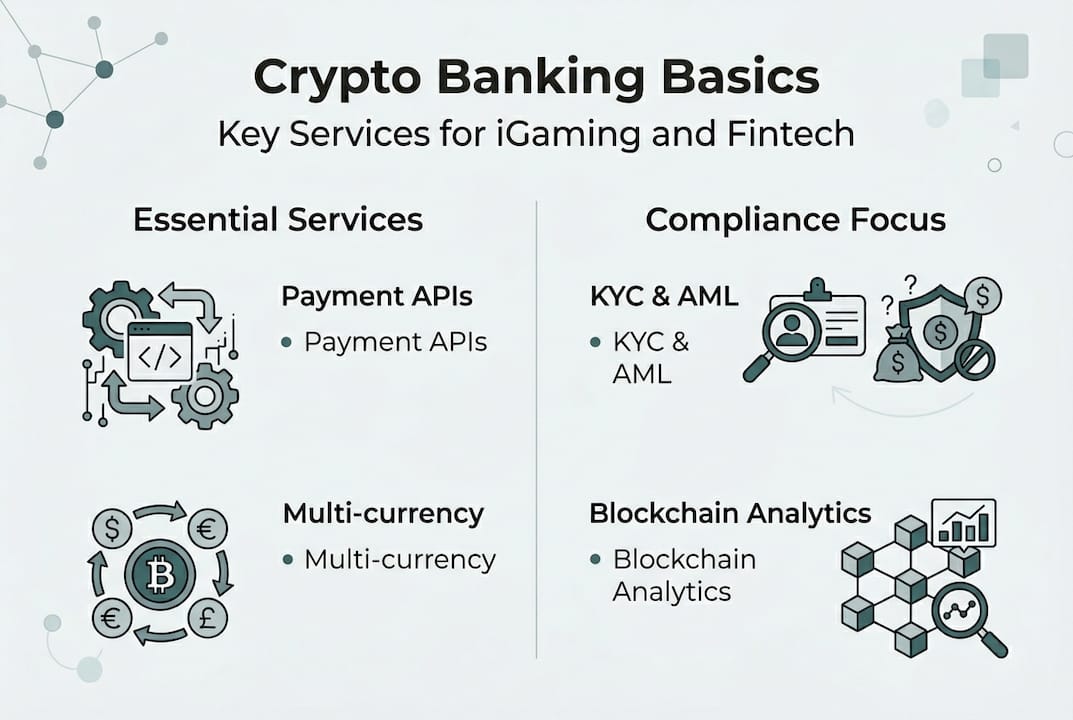
Compliance in crypto business banking is layered and unforgiving. Illicit crypto transactions reached $51.3B in 2024, which is exactly why regulators have tightened requirements across every major jurisdiction. Banks and EMIs that serve crypto businesses must go well beyond standard KYC checks.
Enhanced due diligence (EDD) for crypto clients typically includes:
- Source of funds documentation for all major crypto inflows
- Beneficial ownership verification down to 10% or 25% thresholds depending on jurisdiction
- Real-time transaction monitoring using blockchain analytics tools like Chainalysis or Elliptic
- Ongoing screening against OFAC, EU, and UN sanctions lists
- Travel Rule compliance for transfers above $1,000 (or local equivalent)
The Travel Rule, derived from FATF Recommendation 16, requires virtual asset service providers (VASPs) to share sender and recipient information on crypto transfers above the threshold. MiCA (Markets in Crypto-Assets Regulation) in the EU and AML Directives 5 and 6 add further layers for European-facing businesses.
"Banks must validate the issuer's full financial crime risk framework. AML scoring via blockchain provenance at off-ramps is now essential to prevent illicit inflows." Wolfsberg Group via BIS Bulletin 111
What this means in practice: your banking provider needs to run blockchain analytics at the point of off-ramp, not just at onboarding. If your provider only checks KYC at account opening and does nothing on an ongoing basis, that is a red flag.
For founders navigating this landscape, a solid fintech compliance guide is a practical starting point. Detailed guidance on banking and compliance for fintech and account verification best practices can help you prepare documentation that actually passes enhanced due diligence reviews.
Choosing the right platform: Regulated vs. offshore, EMIs, and common pitfalls
Effective compliance is just one part. Choosing the right banking platform shapes your outcomes from day one.
Traditional banks de-risk aggressively, with roughly 70% rejecting crypto companies outright. That pushes most operators toward EMIs and offshore banks for speed and flexibility, or toward regulated platforms when legitimacy and scale matter more.
Here is how the three main options compare:
| Platform type | Approval speed | SEPA access | Cost | Best for |
|---|---|---|---|---|
| Regulated bank | 4 to 12 weeks | Full | High | Scaling, institutional clients |
| EMI | 1 to 4 weeks | Full | Medium | Fintech, iGaming operators |
| Offshore bank | 1 to 2 weeks | Limited | Low | Early-stage, high-risk structures |
Common pitfalls that derail onboarding:
- Structuring errors: Setting up a BVI holding company without a clear operating entity confuses compliance teams and delays approval.
- Incomplete AML policies: Submitting a generic AML policy instead of one tailored to your specific business model is an immediate rejection trigger.
- Mismatched jurisdiction: Applying to a European EMI while operating under a Curacao license creates regulatory friction that most compliance officers will not overlook.
- Underestimating timelines: Assuming offshore means instant. Even offshore banks now run enhanced due diligence that takes two to four weeks.
For operators exploring licensing options, reviewing fintech licensing examples gives a realistic picture of what regulators expect. If you are considering Asia-Pacific structures, understanding banking in Hong Kong for iGaming operators is worth your time before committing to a structure.
Pro Tip: Offshore accounts can get you operational faster, but if you plan to process SEPA payments or work with European payment partners, a regulated EMI account running in parallel protects you from being cut off when your offshore provider hits a correspondent banking issue.
A fresh perspective: Why legitimacy often beats speed in crypto business banking
Having weighed platform choices, here is a candid take on what truly drives sustainable success.
Every founder we work with initially wants the fastest path to a live account. Offshore banks are attractive for that reason. Low cost, quick approval, minimal friction. But here is what most people learn the hard way: a fast account that gets frozen six months later costs far more than a slow account that works for five years.
Regulated platforms take longer. The onboarding is more demanding. But they offer something offshore banks cannot: correspondent banking relationships, SEPA access, and the kind of institutional credibility that lets you partner with payment processors, game studios, and enterprise clients who run their own due diligence on your banking setup.
The counterintuitive truth is that patience during onboarding is actually a growth strategy. Operators who invest in Hong Kong banking structures or regulated EMI relationships early scale without hitting banking walls later. The founders who chase speed often rebuild their entire payment infrastructure within 18 months. That is expensive and disruptive. Build it right the first time.
Next steps: Secure your crypto business account with Deincepstart
With a clearer view of the options, now it is time to act on your business goals.
At Deincepstart, we specialize in exactly the problems this article covers: getting crypto businesses, iGaming operators, and fintech founders into the right banking structures without wasted applications or compliance surprises. We handle corporate account placement, EMI introductions, offshore structuring across BVI, Cayman, Nevis, Seychelles, and Mauritius, plus VASP and EMI licensing support.
If you are ready to stop guessing and start building a banking infrastructure that actually holds up under regulatory scrutiny, our team is ready to map out the right path for your specific structure. Explore our crypto business banking solutions and connect with an advisor who understands your industry from the inside out.
Frequently asked questions
What types of companies qualify for crypto business banking?
Crypto exchanges, payment processors, fintechs, and iGaming firms typically qualify, but each must meet rigorous compliance standards tailored to cryptocurrency-related business models.
How do regulators verify compliance for crypto business accounts?
Banks and EMIs use enhanced KYC/AML, the Travel Rule, and blockchain analytics tools to screen applicants at onboarding and monitor transactions on an ongoing basis.
Are offshore crypto banks riskier than regulated platforms?
Offshore banks offer fast onboarding and lower costs, but they carry real risk from limited SEPA access, weaker correspondent banking relationships, and less rigorous oversight compared to regulated platforms.
What is the approval rate for crypto business banking accounts?
Specialist platforms report up to 87% approval for crypto businesses, compared to roughly 30% at traditional banks, making provider selection one of the highest-leverage decisions you will make.